The episode on YouTubeOpen on YouTube ↗
Pain Free Friday, episode two. Watch the video above, or read the whole thing here.
Living with pain really changes your brain, especially if the pain is persistent.
Listen, I have a juicy episode for you today. I just got out of a networking meeting with medical doctors from the University of Washington. There's a pain clinic, and they all specialize in pain, and we actually talked about how pain changes the brain, how pain affects people on an everyday basis.
And also, did you know that gay and bisexual men report higher numbers living with chronic pain, or with pain? This is something that was new to me. Again, educational, a revelation.
And I definitely talked about how hypnosis can actually help with pain, and I got a really, really warm response from medical doctors and clinical psychologists who specialize in pain management. And that's what I'm talking about today.
Who I am and what I do
So if you're new to me, my name is Eugene Berezin. I'm a registered hypnotherapist with the state of Washington. I am the founder and owner of Good Hypnotherapy, a practice where I provide pain management with hypnotherapy. And this is the Pain Free Friday series.
In my hypnotherapy practice I also work with gay and bisexual men who run businesses, gay and bisexual men who are recovering from codependency and divorce, and maybe living with somebody who is using substances.
Before hypnotherapy, I worked in social services. I have a master's degree in clinical psychology. I have the SUDPT credential. I'm an addiction counselor, substance use disorder professional trainee.
But what is important to you is that I provide pain management with hypnosis in my private practice, Good Hypnotherapy. And I brought you the numbers before: gay and bisexual men report higher numbers when it comes to living with pain and chronic pain, and this is something that we need to pay attention to.
So let's get started. How pain changes your brain and affects you.
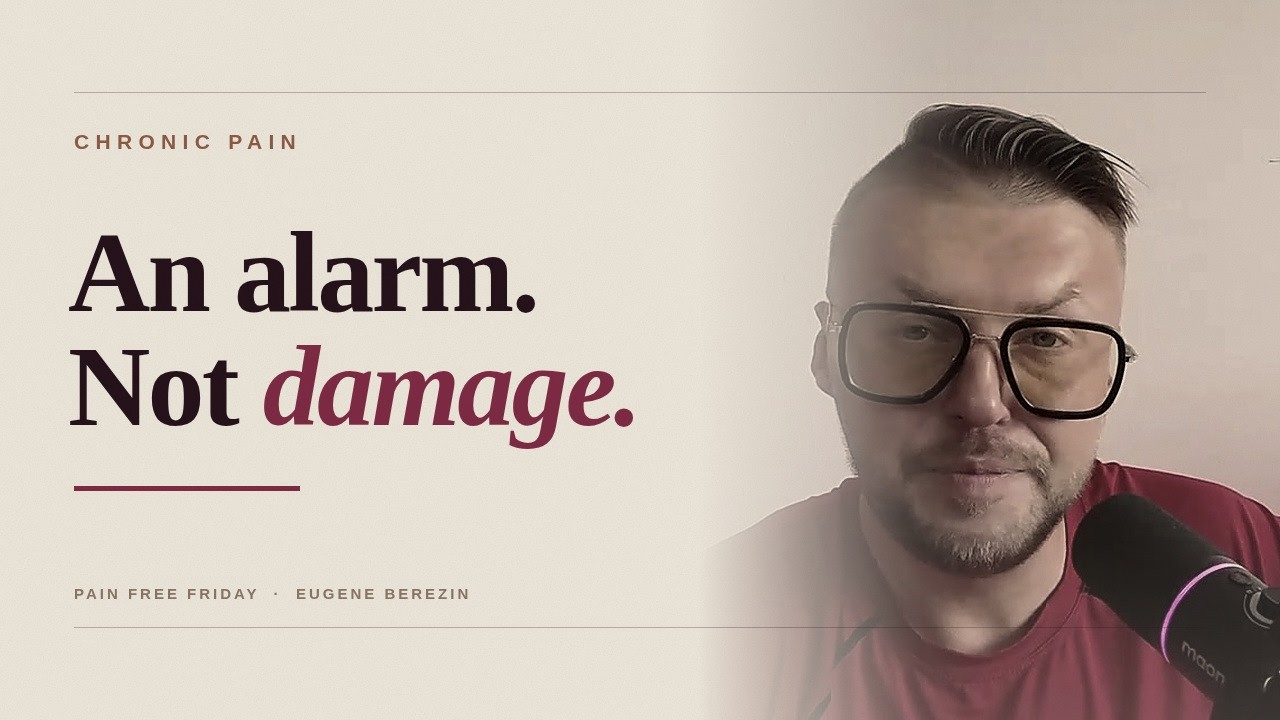
Pain is an alarm, not a damage report
First of all, pain is an alarm. A brain alarm. When we feel the pain, or when we perceive something as painful, our brain gets activated. We have the salience network that basically decides what is urgent and what is not.
We have the dACC, the dorsal anterior cingulate cortex. It's designed to spot mistakes, discrepancies, adjustment in behavior, and it also regulates how we feel pain.
What was important during the presentation today at this meeting I attended: one of the medical doctors gave this example. There was an experiment where a wasp landed on a person, and I'm paraphrasing, and the person felt the pain. The pain registered before the sting, before the actual penetration of the skin.
And this is really important, because we do have physical pain. We do have pain receptors, we do have nerves, and we do feel pain. But we also have, in our brain, interpretation and perception of the pain.
Basically, when we are in pain, our brain registers it as something urgent or unsafe. Something urgent or unsafe. And even if it registers as urgent or unsafe, it is not necessarily true. Just because we feel pain, does it mean that it's urgent? Does it mean that it is unsafe?
Where emotional and physical pain overlap
What is also interesting is that people who experience pain after injuries, or people who live with chronic pain, at some point there is an overlap between emotional pain and physical pain. And it is because of the dACC, the dorsal anterior cingulate cortex.
It's really interesting, because we also sometimes talk in psychiatry and psychotherapy circles about rejection sensitive dysphoria, when rejection feels like physical pain.
Meaning, avoidance and anticipation
But what is really important for you is that in our brain, in our thoughts, we start assigning meaning to pain. And that basically grows into task avoidance. Meaning we stop moving, we stop performing activities that are necessary for our daily lives. It affects our sexual desire. It affects our mood, and it affects our mental health.
And often, fear of the pain, anticipation of the pain, creates painful experiences.
And what is really interesting too, something that I'm taking from that meeting: when we talk about pain management with medication, like opioids, like Vicodin, over time it becomes evident that sometimes, often, those medications start treating emotional pain.
Does that mean it is in your head?
And does it mean that the pain is just in your head? For you, pain is really real. And this is why I talk about how pain changes the brain.
It's anticipation, it's assigning meaning to the pain, it's task avoidance, it's catastrophizing. Because when we feel pain, we start catastrophizing, even if we're not in danger. We use thoughts like, my body is falling apart. And this is not true. The body is not falling apart. It's just feeling the pain. Nothing becomes truly dysfunctional. Just because it hurts doesn't mean that part of your body is dysfunctional. It means it hurts.
Parts work and Internal Family Systems
And then we really decouple and interrupt those thoughts. In my practice, I often do parts work, with Internal Family Systems as a foundation. We start addressing those parts that are activated.
Internal Family Systems basically operates on this philosophy that we have multiple parts in our mind, and those parts get activated. We most often don't notice them when they're acting right, when they're helping us perform activities. But when we are in pain, when we are hurting, when we are experiencing trauma, those parts are activated. With pain, parts work can be really helpful.
And this is anecdotal evidence that I'm seeing in my practice. I asked the doctors and physicians at that meeting, hey, what do you think about IFS? Because my anecdotal evidence is that it helps. And I got a really, really warm response to that.
What pain steals, and psychosomatic pain
So yes, pain changes the brain in a negative way. Mostly, it is really stealing the joy and activity and function from our daily life. That is a really debilitating thing.
And the crazy part is that over time we just feel the pain, and it becomes emotional, especially when we have complex trauma or PTSD, or really traumatic experiences in the past. That can become psychosomatic. Psychosomatic pain is also real. This is something that we also talked about in the meeting.
When something triggers our pain, it can be psychosocial, right? It can be from our environment, it can be from our complicated relationships, it can be from our business.
Rejection in business, the same neighborhood
Listen, as business owners, and I started talking more to business owners on my channel too, when we live with pain, for us it is extremely complicated, because we are constantly subjected to a higher amount of stress. Our business, our relationships and our daily lives affect us on an everyday basis, big, big, big time. Especially when we're experiencing lows in our business, especially when we experience rejection in our business.
Because listen, if you're running a business, whether you're running a restaurant, a brick and mortar business, a coaching business, a private practice, you will experience rejection. I experience rejection on an everyday basis. Somebody is not returning my referral. Somebody said, no, we cannot be your referral partner, we only work with medical doctors. Somebody is not responding to my email. Somebody is ghosting me on my consultation. That is rejection, right?
And in our brain, sometimes, not all the time, it can actually activate the same neighborhood in our brain. And imagine if we live with pain and stress. Stress-related headaches, stress-related migraines. Pain that is triggered by psychological stress is really real, y'all.
The number nobody is talking about
And more importantly, what is really shocking to me is that we, gay and bisexual men, have a higher chance of experiencing chronic pain. And this is why I opened Good Hypnotherapy. And this is why I show up every week on my channel, on Tuesday, and now on Friday, Pain Free Friday.
Because with our providers, yes, medical doctors, psychologists, social workers, therapists, it is so essential to work with a provider who understands us. Especially not just from the standpoint of who we are as gay and bisexual men, but also gay and bisexual men who run businesses, gay and bisexual men in highly demanding careers, gay and bisexual men who have to show up every day in our work, in our businesses, and be publicly visible. Gay and bisexual men who, on a daily basis, might experience discrimination as business owners.
Somebody looks at us like, you know what, no, I'm not working with a gay guy. I'm not going to that gay restaurant. I'm not going to that gay masseuse, he's gonna touch me. Like, what do you do? You provide professional massage services. You're not doing anything questionable, like what people put on their OnlyFans pages. You are a professional. You are a doctor. I'm not going to a gay doctor, I need a different doctor. I don't want a gay teacher to teach my son. I don't want a gay tutor to work with my kids. I don't need a gay coach to coach the team at my school. You know what I mean?
Other men perform the same work, run the same businesses, perform the same operations. And sometimes we choose not to disclose that part of ourselves because of fear of rejection. And when we live with chronic pain, y'all, and the numbers are higher in our population, that becomes difficult.
This is not a replacement for medical care
And when you go to a doctor, when you go to a provider who doesn't understand you, who just sees the pain in you, and the medications and the treatment that provider prescribes you, do they work for you? And if they don't consider the psychosocial component, that becomes problematic. Because listen, we can't treat our body without addressing our mind.
Listen, I'm not saying that hypnotherapy is a replacement for medical intervention. I'm not saying that hypnotherapy is better than medication or physical therapy. Physical therapy can be amazing. I'm saying that a combination of both can be really therapeutic.
Also, if you choose not to take medication, or if you're at the point of giving up, like, what else can help me? Go try hypnotherapy. I can't promise you that it will work. But what I can promise you: if you don't try, you never know.
And please leave your questions in the comments. If you have questions about pain management, if you have questions about hypnotherapy and how hypnosis can help with pain.
What the psychologist told me about hypnosis
And by the way, because it's me, I asked the licensed psychologist at the presentation, what do you think about hypnosis? She was talking about mindfulness and meditation. And, crazy, I was the only expert in hypnosis there. She said, I'm not an expert in hypnosis, but if you have access to hypnosis, if you have an opportunity to go and try hypnosis, do it. Those are her words. And that was really validating for me, because the research is there. We have studies, we have sources.
You do not have to be gay to work with me
So if you live with chronic pain: by the way, you don't have to be gay to work with me on pain management. I welcome everybody, because I know how debilitating pain can be. But I'm emphasizing it because nobody else is telling you. Nobody else is pointing out that number, that we are at risk, that we report higher numbers of pain and chronic pain. And that's why I'm here.
I love you so much for listening. Next Pain Free Friday, I'm going to talk about how to select a provider: how to understand if they're qualified, how to work with them, what questions to ask, and how to prepare for a pain management visit. I hope to see you there. So stick around, and I will keep talking about pain on Pain Free Friday, every single Friday. Bye, y'all.
Work with me on pain
If you live with chronic pain and want to work on it with me, go to painreliefhypnosis.org and send a request through the site. I will reply within one to two business days with intake paperwork and a link where you pay and pick your time in one step. 60 minutes, $250, online, private pay, HSA and FSA accepted and superbills provided. You get a personalised hypnosis recording made for your case, and I teach you self regulation so you are not dependent on me.
How hypnosis works for pain, in plain language: painreliefhypnosis.org/how-hypnosis-works-for-pain
I do not diagnose. I work in Internal Family Systems and motivational interviewing, and where something underneath needs a licensed mental health professional, I have someone in my network I trust and I refer.
Two corrections to what I say in the video
At 6:20 I call it rejection sensitivity disorder. It is not a disorder and it is not in the DSM. The informal term is rejection sensitive dysphoria, usually discussed alongside ADHD. The underlying finding still stands: social rejection activates the same alarm circuitry as physical pain.
At 14:27 I say gay and bisexual men have a higher chance of chronic pain. The big study, 134,266 US adults, is of sexual minority adults and does not split its headline numbers by sex: 21.7 percent of gay and lesbian adults and 23.7 percent of bisexual adults, against 17.2 percent of straight adults. A separate, smaller study of men found the clear gap in bisexual men specifically, 26.1 percent against 19.6 percent.
The research in this episode
The salience network as the brain's alarm desk: Seeley et al. 2007, Journal of Neuroscience 27(9):2349.
Most of the so-called pain matrix responds to any urgent stimulus, not only painful ones: Mouraux et al. 2011, NeuroImage 54:2237.
Social rejection activates the same alarm region: Eisenberger, Lieberman and Williams 2003, Science 302:290. The fine-grained patterns for physical pain and rejection still differ, so these are overlapping circuits rather than the same signal: Woo et al. 2014, Nature Communications 5:5380.
Expectation changes felt pain: Koyama et al. 2005, PNAS 102(36):12950.
The fear and avoidance loop: Vlaeyen and Linton 2000, Pain 85(3):317.
Catastrophizing and brain response: Gracely et al. 2004, Brain 127(4):835.
Chronic pain in sexual minority adults: Zajacova et al. 2023, Pain 164(9):1942. Men specifically: VanKim et al. 2024, American Journal of Preventive Medicine 67(4):586.
This first went out as a letter on my Substack on October 2, 2026. If you would rather get these by email, subscribe there.
If this is where you are
I work with this one to one, online, wherever you are.
Request an appointment (opens the secure SimplePractice appointment request form in a new tab)