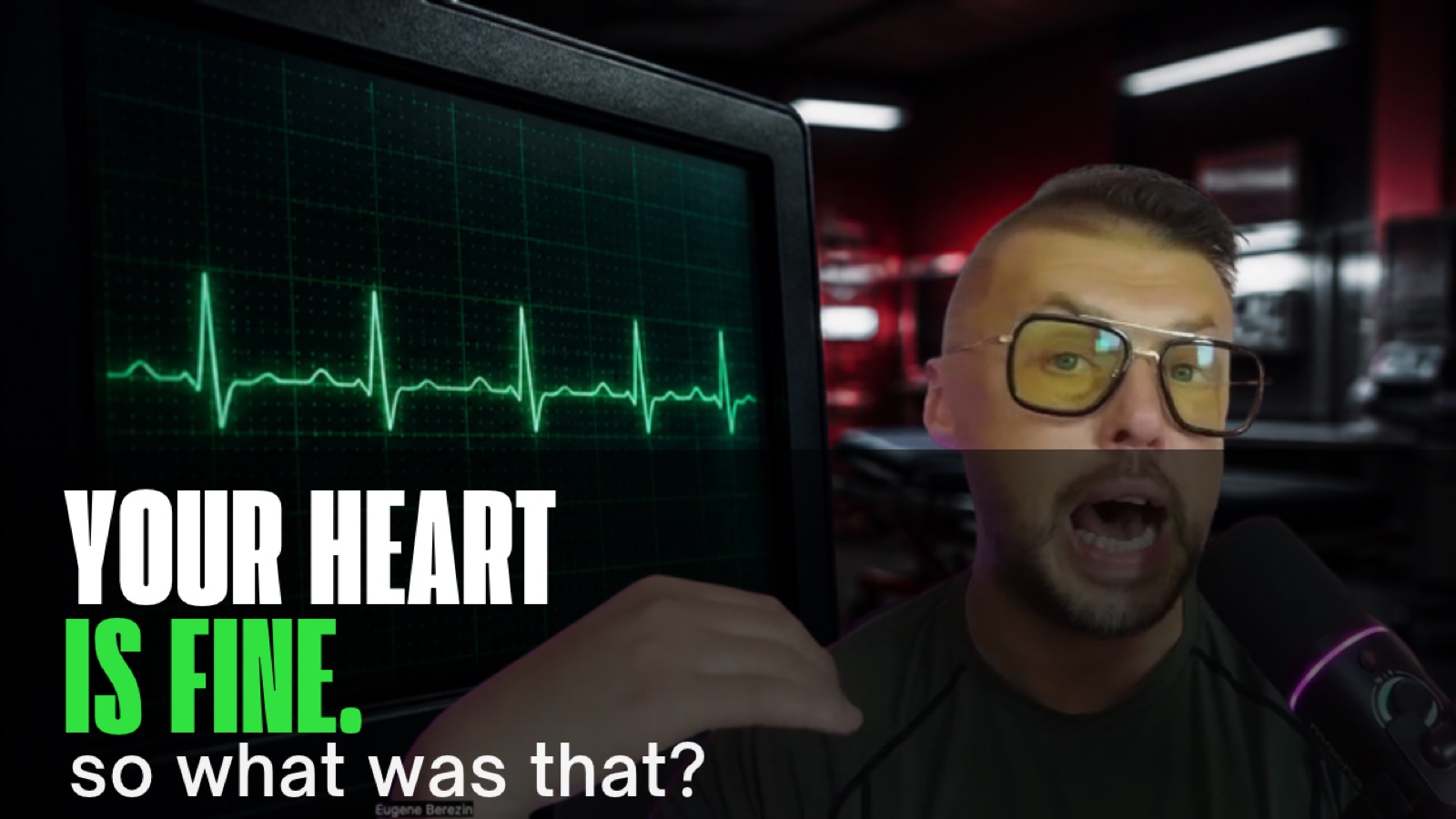
The episode on YouTubeOpen on YouTube ↗
You had a panic attack, or you went to a doctor and the doctor says it's fine, right? Maybe you felt like you had a heart attack, or you felt something is physically wrong with you. Maybe you got sick before an important meeting, or after. But the doctor says, you know what, everything is actually fine.
That was my story in the previous video. I talked about how to recognize a panic attack if you never had one, and especially if you don't identify as an anxious person. Because here's the thing. People might have a misconception: I don't have panic attacks. Or they don't understand why they would have a panic attack. I'm not an anxious person. I am fine. I'm very confident. That was me too. And when the doctor said, you know what, you're perfectly fine, I had to look deeper.
In this one we're going to talk about what is actually happening, or what could be happening, with you and with your nervous system, and what you might possibly consider.
What it looked like: sick, throat closing, in front of the board
So let's say you got physically unwell. And this is a general statement that I am seeing in multiple clients, not one client specifically. Either you got sick and you threw up, or you felt a sensation like your throat is closing and it's hard to breathe, or maybe your throat got dry and you needed extra water and it was really uncomfortable.
And it happened either when you were in public, when you were presenting, when you were on stage. It didn't happen when you were chilling at home, comfortable, and all of a sudden. Although it can happen sometimes. But what triggers you, or what really concerns you, is: how do other people see it? It's not just you by yourself. You're in front of the board, you're in front of the client, you are presenting, and this happens. And the doctor says that everything is fine.
My understanding of what is happening
So this is my understanding of what is happening, especially in entrepreneurs, especially when people have other stressors. Minority stress, for example.
The concept of minority stress is this. As gay and bisexual men, or people from underrepresented backgrounds, we live with the daily stress of being not safe, being rejected. Because people do reject. People do make choices not in our favor because we are gay. Not because we're not qualified or we are not equipped. Because we are gay. There are people who are not liking us, gay and bisexual men.
Killing it professionally, personal life on the back burner
And that ends up as relationship stress too. Because it's very, very common, when we are killing it professionally, maybe we're making six or even seven figures in our careers, maybe we are in executive roles, maybe we are running a business that is really successful, but our personal and romantic life is on the back burner. Or maybe we have stress and problems with our marriage. Maybe we went through a divorce. Or there are other factors too, like changes in the business itself. A lot of businesses right now are struggling because of AI, because of how people changed their buying behavior.
Running on overdrive for way too long
And we have that physical symptom. It simply means that you were running on overdrive for way too long. Because that was me, personally. That could be one of the reasons. Again, the nervous system is complex, I don't know you personally, and to say it ethically: one of the reasons is because you were running on overdrive. You were handling it. You were the strong one. You overcame a lot of challenges. You're not an anxious person. I mean, you do have anxiety. But you may not identify as an anxious person.
Because I recently went to therapy, and when I saw my therapy notes that my therapist shared with me, I saw "generalized anxiety disorder." I disagree. I don't identify with that. And although I understand why he would think that, or put that diagnosis, because anxiety is there, I don't think of myself as an anxious person. But that is what running on overdrive does.
Powering through a crisis with no one to lean on
When I say running on overdrive, what I mean by that: you are constantly powering through a crisis. You're the strong one. You don't have an effective support system. You don't have community. You don't have your therapist. You don't have a person that you can lean on. Maybe you do have your meditation retreats, or maybe you have your business coach. But as soon as you need support, as soon as you need to lean on somebody and get that support from somebody, your partner is not providing it, your coach is not providing it, your sound bath meditator is not providing it.
So at some point your body, your system, just tells you: you know what, I'm done. The nervous system needs lubrication. And that's one of the reasons it could happen, and could manifest. Again, it doesn't have to look like a heart attack. But if you notice that, and you never had that before, that's why.
ENT, GP, cardiologist, GI: a $1,500 procedure
Now, when it happens, I do agree with my medical doctors that I went to: check all the systems. But after I saw an ENT, after I talked to a general practitioner, and the inhaler that he prescribed me did not work, after I talked to a cardiologist, and after a GI doctor, a gastroenterologist, said, you know what, we need to do a $1,500 procedure to actually see whether your esophagus and your system are normal, because that could be an issue, I said no.
I actually told that doctor: as a person who spent a decade in mental health as a therapist, clearly you're over-diagnosing me right now. Let me do one thing. I will start addressing it from the mental health standpoint. I will do meditation, I will do therapy, I will do hypnotherapy. And if, after 90 days of that effort, it's not subsiding, it's getting worse or it stays the same, I will come back and I will continue medical testing, because evidently something is wrong.
And what do you know. As soon as I started addressing my stressors and started implementing the mental health hygiene that I talk about on my channel, the symptoms went away.
Option one: talk therapy with the right therapist
Now, what are the options that you might consider moving forward? You might consider talk therapy. It's essential to pick a therapist who understands you. Especially if you're a gay or bisexual man and an entrepreneur, your therapist has to understand both. They also have to understand this very specific issue: fear, phobia and panic attacks. That's important, because if you're not addressing that, if you're not diving in underneath, that may not work out. And you have to like your therapist.
Option two: hypnotherapy
The second option, and I'm a little biased, is hypnotherapy. Hypnotherapy is quite short-form therapy. You can work with a hypnotherapist up to 12 to 14 sessions to really understand how to regulate your nervous system.
For me personally, how I specifically work: I am a registered hypnotherapist in the state of Washington, and I have a lot of experience in mental health as a therapist. So specifically how I set it up. You can do an intensive. It's a three-day intensive, when we work three days consecutively and we address that. It's really good, especially if you need to get yourself regulated and ready before a presentation. Maybe you know that you have a big event coming, and you don't necessarily have 14 sessions, or eight sessions, to wait until it gets better. An intensive can work, might work better. Again, ethically, I cannot promise you that. But it can be a tool in your toolbox.
If you just want to understand, if you just want it to stop, period, and work on deeper regular self-regulation, then six to 14 sessions is normally enough to address that. After that, we can transition to lifestyle therapy, when you see me on a regular basis, either weekly, or once a month, or every other week, however you want to do it. But that will be your mental health maintenance and mental health hygiene.
I work with entrepreneurs. I know both worlds
We start with a precise focus. I work with entrepreneurs. I know both worlds. I know what it is like to be a gay entrepreneur and show up as a gay entrepreneur. For a long time I didn't know if I wanted to be open about it or not, if it was going to be good for my marketing or not. And it takes a lot of courage to actually say on camera: I'm also an entrepreneur. I run a business. I built my coaching business. I went through ups and downs. I experienced that myself. So I know your experience really precisely.
You can book an appointment with me at goodhypnotherapy.org.
You need professional help, not just meditation
Those are your two options. Because I'm not going to tell you to just go meditate, just go relax. You need professional help. When your system is running the alarm, when you are not physically well and the doctors cannot pinpoint what the hell is going on with you, you need professional help, either from a licensed therapist or a hypnotherapist who understands human psychology. I worked in the past as a therapist, I have a master's degree in psychology, and I'm an entrepreneur.
Next: triggers
In the next one, we kind of already addressed where it's coming from, but I would like to talk about the trigger points for panic attacks specifically. Today we talked about what happened: you're physically healthy, you're good, your doctor said, you know what, let's do another test, or you just realized that you're running out of tests and the doctors cannot pinpoint what's going on with you. Next we're going to talk about triggers, and about the internal mechanism that can trigger those events. The stage performance. Life events that can trigger it. Past trauma as well. Those panic attacks in the most inconvenient moments.
I love you so much. Stick around with this playlist, The Panic Attack You Didn't See Coming.
This is a series. If you missed episode one, here it is: What a Panic Attack Feels Like When You've Never Had One
Request an appointment: goodhypnotherapy.org
Eugene Berezin, MS, SUDPT, RHt, Washington State Registered Hypnotherapist. This is education, not medical advice. Get the physical checked first. If you're in crisis in the US, call or text 988.
This first went out as a letter on my Substack on October 26, 2026. If you would rather get these by email, subscribe there.
If this is where you are
I work with this one to one, online, wherever you are.
Request an appointment (opens the secure SimplePractice appointment request form in a new tab)
