The episode on YouTubeOpen on YouTube ↗
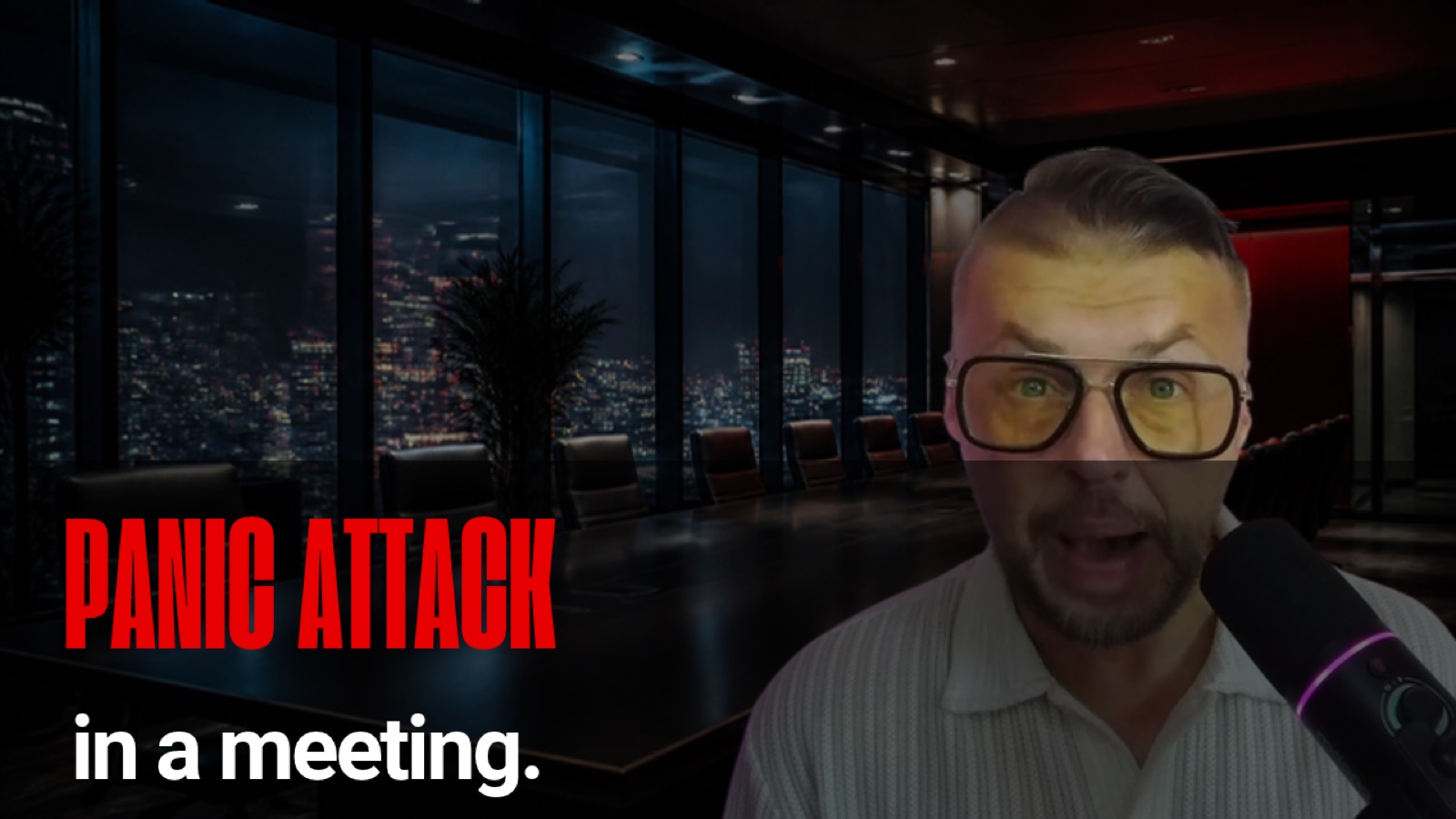
Have you ever felt physically unwell right before an important meeting, or as you're presenting? You feel like the throat is closing, or your heart is beating crazy. Or maybe you even got sick and threw up, right before an important meeting or right after it.
So I'm going to talk today about a phenomenon such as a panic attack. And a panic attack may not manifest the same. A lot of the time, when we hear about panic attacks, people talk about, oh, I'm feeling like I'm having a heart attack. But it's not quite like that, because humans don't all work the same. Although a lot of the time a panic attack might feel like a heart attack, and usually it subsides fairly quickly, within a short period of time.
So we're going to break it all down today, and I'm going to share with you my personal experience, when I had panic attack symptoms, what happened to me when I went to medical doctors, and what I think is underneath that. Because this is something that I have seen in executives and entrepreneurs and people in high-demand careers.
High-demand careers, a divorce, everything okay on paper
I was, pretty much for my entire life, in high-demand careers. I was a therapist. I was a software engineer. I was a part of hiring teams. I interviewed people. I'm on social media. I am on stages. I also went through traumatic experiences in my life, such as a divorce, such as relationship problems, such as business problems.
And at one point in my life, when everything was okay on paper, I mean, I had my career success, I had my promotion, I was a part of a hiring team where I was supporting the effort of diversity, equity and inclusion at a Fortune 500 company. Everything was normal. Right before, a year before my divorce. What happened?
Denver: my throat started closing
One day, when I relocated to Denver, Colorado. High altitude, dry climate. We're going to come back to it in a second, and I'm going to tell you why it is important. When we moved there, I started feeling that my throat was closing. And then I felt like, okay, it's high altitude. I read about it a lot. I know how the environment can affect you. And then I felt like maybe it is asthma, maybe it is allergy, maybe it is something else.
But then, after one particular interview, I felt very sick. I went to urgent care, and the doctor said: nothing is wrong with you. All stats are normal. Sometimes people feel funky in Denver, or in Colorado, because of the high altitude.
And by the way, this was not my first rodeo with Colorado. I lived in Colorado Springs for a month prior to that. This was not the first time me being in Denver, in high altitude.
But again, it was right after COVID happened, and we were working remotely. There was a lot of tension in society, but I did not see any signs. But again: living in chronic stress, performing under immense pressure, moving to a new place, getting a promotion, getting higher visibility, a higher position that I may not have fully felt comfortable with. That kind of triggered it.
And then I went to another doctor. I went to a primary care physician, and they said: nothing is wrong with you. They prescribed me an inhaler. Maybe it is a light form of asthma. Spoiler alert: it did not help.
Chicago, the gym, the cardiologist
I moved to Chicago, and this is when my divorce happened. And then I had another, bigger episode at the gym, and I actually thought it was a heart attack. I went to urgent care again. They sent me to a cardiologist, to rule out any cardiac issues. My cardiologist said: you are healthy. The EKG and all the tests are showing that you are completely healthy. There is absolutely nothing wrong with you. And they ordered more tests, until I said stop.
I said stop. As a person who worked as a therapist, and who has seen that in my clients in the past, especially in clients who are high achievers, who are entrepreneurs, who are executives, I had a really good educated guess, although I cannot diagnose myself, that it was psychological. Maybe it is a panic attack. Maybe it is something else. But I had to address that. And I was absolutely right. When I started addressing it with mindfulness, therapy and hypnotherapy, what do you know? The symptoms went away.
Resilient people, and then the body gives out
So a lot of the time, when we are running a business, or when we are in these high-stakes, high-demand careers and high-demand situations, our system... Listen, we are resilient people. And a lot of the time that resilience is a good thing. Resilience is a good thing. But at some point our nervous system and our body just give out, and it's an alarm. It says: you know what, you have to slow down. You have to address that.
So if you are in this situation. Maybe you just got an executive promotion where you are responsible for a lot of things. Or maybe you are in a high-demand career. Or maybe you just feel the changes with AI, with layoffs, with slowness in business. Maybe with the AI tools that you thought would mean you work less, and you're actually working more and producing more. You start feeling that. Maybe you got sick before the meeting. Maybe you got a panic attack in the worst possible moment. This is the body alarm.
Get it checked. Mind and body are connected
The good news is: yes, absolutely, have it checked out with a medical professional. I went to a medical professional first. This is how we're trained. Mind and body are connected. Okay? Mind and body, they're absolutely connected, and this is the evidence of that.
But if your medical doctor just says, oh, must be anxiety related, let me prescribe you, I don't know, Xanax or anxiety medication, without actually addressing the root cause... I'm not against medication, by the way. I'm not against that. But there are other options, or options that can go along with it.
What I would consider: hypnosis and intensives
One of the options that I would consider, and again, I'm a little biased, I'm a registered hypnotherapist, I would consider hypnosis. Especially if you are in a situation where this is new to you and you have to present. There is something that I personally do: intensives. Three days, back to back. We work, and we do therapeutic hypnosis specifically for that, very targeted. And then we just reassess if you need more sessions. It can be regular sessions, or it can be eight to 14 sessions, to recalibrate, to help you re-regulate your nervous system in a way that you have the tools to be self-regulated.
And if it doesn't go away after that, don't worry. But if it's worsening, then it's probably something that you need to discuss with other providers, maybe a psychiatrist or a licensed therapist, to go deeper, because it can mean something deeper than that.
You may not identify as an anxious person
In the next video I'm going to address that. And again, this is really important: you may not identify as an anxious person. I don't identify as an anxious person. But in the next one we're going to talk about what actually happened. So this has happened. You might go to the ER or urgent care, and your doctor says that you're absolutely fine. We're going to talk about the underlying condition.
I love you so much, I wish you well, and come back for the next one.
Request an appointment: goodhypnotherapy.org
Eugene Berezin, MS, SUDPT, RHt, Washington State Registered Hypnotherapist. This is education, not medical advice. A first episode like this gets checked by a doctor first. If you're in crisis in the US, call or text 988.
This first went out as a letter on my Substack on October 23, 2026. If you would rather get these by email, subscribe there.
If this is where you are
I work with this one to one, online, wherever you are.
Request an appointment (opens the secure SimplePractice appointment request form in a new tab)
