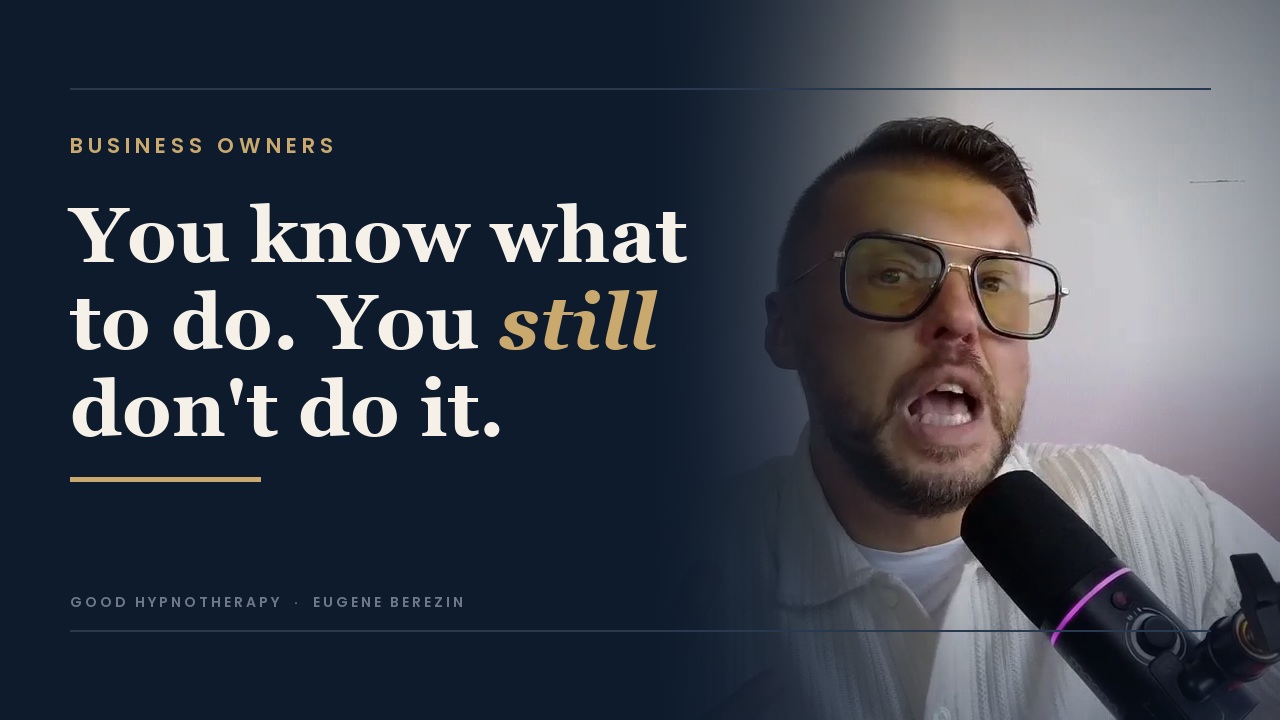
Have you noticed? When you are taking action and you're making a change in your life, whether you go to a therapist or a hypnotherapist, or you work with a coach or with your fitness trainer, you are taking action to make a change. But how do you sustain that change?
Sometimes you're making a change and you're winning in life, you're winning in your business and you're winning in your career. And sometimes you're taking action and it's not actually working.
So that's what we're going to talk about today: how to maximize your work with your hypnotherapist, with your coach and with your therapist, because they're all interconnected.
Sometimes the same action stops working
This is something that I noticed. I worked for many years as a therapist in Moscow, Russia. I have a master's in clinical psychology, and I also run my private practice as a clinical hypnotherapist. I am a registered hypnotherapist in Washington, and I work with people across the country. I work with a lot of people who run businesses, with a lot of entrepreneurs.
And what I notice is that when we're making a change, sometimes it works. And sometimes the same action that we were taking before stops working.
So we're going to talk about the implications for your mental health: what happens, why it happens, and the nature of change, because this is something that I have not talked about. And the possible underlying issues that come with being in a high-demand career, when you're a founder, when you run a business, or when you're in a career with high stakes.
Because this issue, when we're taking action and at some point the action stops working, or when we're taking action and we're not seeing the outcome that we desire, can happen in therapy. It can happen in coaching. It can happen in business.
And by the way, this lesson will be applicable to so many different life situations. For your mental health. If you're battling addiction, absolutely, this is for you. And if you're running a business, this will be applicable across the board.
The nature of change
So what is the nature of change? How does change happen?
If we talk about it from the standard scientific psychotherapy standpoint, the nature of change is documented. It starts with precontemplation, when we might be in denial about something, or it's just a spark. It's just an idea. Like, you know, maybe it is not okay that my mind is always on, always running. Maybe it's not okay that I constantly have mental spirals and I cannot regulate myself. Maybe it is not okay. Maybe there's something wrong with me ending up in the same relationship that I constantly end up in, with guys who cannot provide for me, who cannot be an equal partner with me, who always take advantage of me, who are not emotionally available. That's precontemplation. It's the thought before the thought, before people actually start thinking about it.
The second stage of change is contemplation. That's when we actually start thinking about making a plan. In addiction circles, for example: okay, maybe I do have a problem. Maybe I do drink too much, or maybe my substance use is affecting me. Or in business, when we think: okay, this is not going to work out, I need to do something different. I cannot be reactive with the people who work with me, with my clients, with my partner, with my spouse, with my loved ones, with my family. I have to make a change. I'm not sleeping. I'm not happy. Why am I doing this if I can't live my life by design? That's contemplation. It's a decision-making process.
Then preparation. You look for a coach, you look for a therapist, you look for a hypnotherapist, a person who can help you make a significant change. You look for a business partner. It's preparation. You take steps to prepare.
And then you take action. You go to therapy. You go to coaching. You hire or fire people, and that will have a lasting impact on your business.
And after that, you maintain your result. Sometimes the result is not maintained. Sometimes maintaining the result means starting the cycle all over again: okay, it used to work. Listen, if you're a business owner, you know that something that used to work stops working, and it's perfectly fine.
Our brain seeks safety
From the psychological standpoint, when we have significant changes (and I will be talking about that more next week), listen, as humans, we are designed for safety. Our brain seeks safety, wants safety, wants stability. And entrepreneurship is anything but stability. And then we have difficulty adjusting.
Adjustment disorder and your business
In the DSM-5, there is such a thing as adjustment disorder. And I was digging into it, by the way: adjustment disorder in entrepreneurship. There's not a lot of research on that, but this is my personal reflection, and I think we need to look at this more.
When something changes, right? Your ads are not converting, or something big is happening in your business. Then, probably within three months, you start developing anxiety. You start developing emotional spirals. You start experiencing distress. You start being uncomfortable. And it causes emotional suffering.
And what is interesting about adjustment disorder, and why this very much qualifies as adjustment disorder: when that stressor goes away, the symptoms go away. Your business is up and running, your stress goes down. Your numbers are up, your stress is down. In a way, you kind of breathe entangled with your business.
And I really think we need to look into that. We talk a lot about resilience, but this is a psychological response to a change. When we tie our identity and our value to what we're building in our business, we might react with adjustment disorder.
I'm not diagnosing you, I'm educating you
Now, I'm not diagnosing you. I'm educating you. This is psychoeducation.
So why am I telling you that? First of all, to normalize what you're going through. You're taking action, and the action stopped working. I went to therapy before, and it didn't work. I did hypnosis before, but now I'm at the same place where I started.
Business is not constant. There are changes all the time: in the economy, in people's behavior, in you and your identity, because you grow. How many business owners pivot out of nowhere because they feel like it? The same in your career.
When tech stopped being stable
Listen, I spent 10-plus years in tech. I have this really unique combination: I'm perfectly qualified to work in the mental health field, and I actually worked in mental health for many years, even in the US, doing case management, counseling, youth counseling and social work. Now I'm running my private practice as a registered hypnotherapist in Washington, and I work with people across the country, across the world, honestly.
And this is what I'm seeing too. Three, four, five years ago, tech was a stable career. Then the economic changes came, and now it's just impossible to land a good contract. That creates a lot of emotional disturbance. And then people start thinking: what am I doing with my life? What is next for me? Because tech is clearly not working. I'm out of a job. Or, I had a business in tech, we had a software development agency, and now everybody can do vibe coding. What do you do?
That can cause disturbance, and that can cause a relapse in your results. So you're kind of starting over, and this is normal.
Change is not linear
I want to say that the stages of change are not linear. It is normal. Sometimes life is happening. You're taking action, and then you're back to precontemplation: you know what, it's not even worth it.
It's okay to fire your therapist
Sometimes therapy is not working because you picked the wrong fit for you, and the therapist is not the right fit. And it's okay to fire your therapist. It's okay to fire your hypnotherapist. It's okay to fire your coach.
But address that it is not happening for you. Address that change is not happening for you. Don't just leave. Talk to your coach, to your therapist, to your hypnotherapist. Say, "You know what? We're working on this thing, and it's not working."
This is what I tell my pain management clients. I say, "Hey, if we're three sessions in and nothing changes, after the fourth session we have to look at it. Maybe I need to do a different kind of hypnosis for your pain management. Or maybe hypnosis is not good for you. Maybe I'm not the right fit. We are troubleshooting. Maybe the timing is not working."
It's the same with my business clients, when people come to me for emotional regulation, to end the spiral, to address their relationship issues, or for divorce recovery. We work together, we do hypnotherapy, we do self-regulation, and we're always changing things and always requesting feedback. If it's not working, or if you need a different level of care, or if you need a different type of provider, it's okay to let them know that you need something different.
That's what it means to take action.
Your nervous system will react
If you're currently taking action and it's working for you, I'm happy for you. Keep working.
But I'm also telling you that when change happens, your nervous system will react to that change. And it's okay. It doesn't have to be adjustment disorder, by the way. I'm bringing up adjustment disorder specifically for people in high-level careers, in entrepreneurship, for founders, because we constantly experience changes, and we are responsible for a lot. So that is okay.
The way change happens is from precontemplation, to contemplation, to preparation, to taking action, to maintaining your results. And sometimes you have to start all over again. Sometimes you fall and make a mistake and relapse, and that's part of the life cycle. It's part of change. That's what it is.
So if you're taking action, or if you're thinking about taking action, I really hope this is helpful for you.
This is how you take action
If you're looking for professional clinical hypnotherapy specifically designed for you: I work with business owners who are in the thick of it, for stress management, divorce or breakup recovery, codependence, and specifically for managing your nervous system and managing stress with your business. And I do pain management.
Go to goodhypnotherapy.org. First of all, you can learn more about me, my background and the services I provide. And you can request an appointment through a secure SimplePractice link. You'll fill out a few easy questions and select whether you want to request your first clinical session or a consultation.
Personally, if you know that you're ready to make a change, I would request your first appointment. Then you can simply see how it works. I review your documentation, I send you easy paperwork to fill out on SimplePractice, and then we have your first session. This is how you take action.
And if it's not a good fit, I have referral partners in Washington, and I will make a referral.
I love you so much. Keep taking action.
Next week: maintenance
Next week, we're going to talk about maintenance: how to maintain good results overall. And we're going to dive deeper into adjustment disorder, because this is something that is really on my mind. Again, this is my personal, anecdotal observation, but entrepreneurs a lot of the time have undiagnosed adjustment disorder. It's not glaring. It shows up as anxiety. Sometimes it can mimic certain things of OCD. It's not the same thing, and not always. But because business is always changing: when it goes down, your stress goes up. When it's changing, your anxiety goes up. When something is not okay, you're not okay.
I love you so much. Keep building and keep growing.
This is education, not therapy or a diagnosis. If you're in crisis in the US, call or text 988.
One thing I want to be clear about. I don't treat addiction independently. If you're in active addiction, you need a treatment provider, and I can work with you as part of your care team. If you're the partner, or the ex, or the one holding it all together, I can work with you directly.
This first went out as a letter on my Substack on October 13, 2026. If you would rather get these by email, subscribe there.
If this is where you are
I work with this one to one, online, wherever you are.
Request an appointment (opens the secure SimplePractice appointment request form in a new tab)